Tesla Drops $108M On 400-Stall Desert Supercharger Hub—Shatters Its Own Record In Just 4 Months
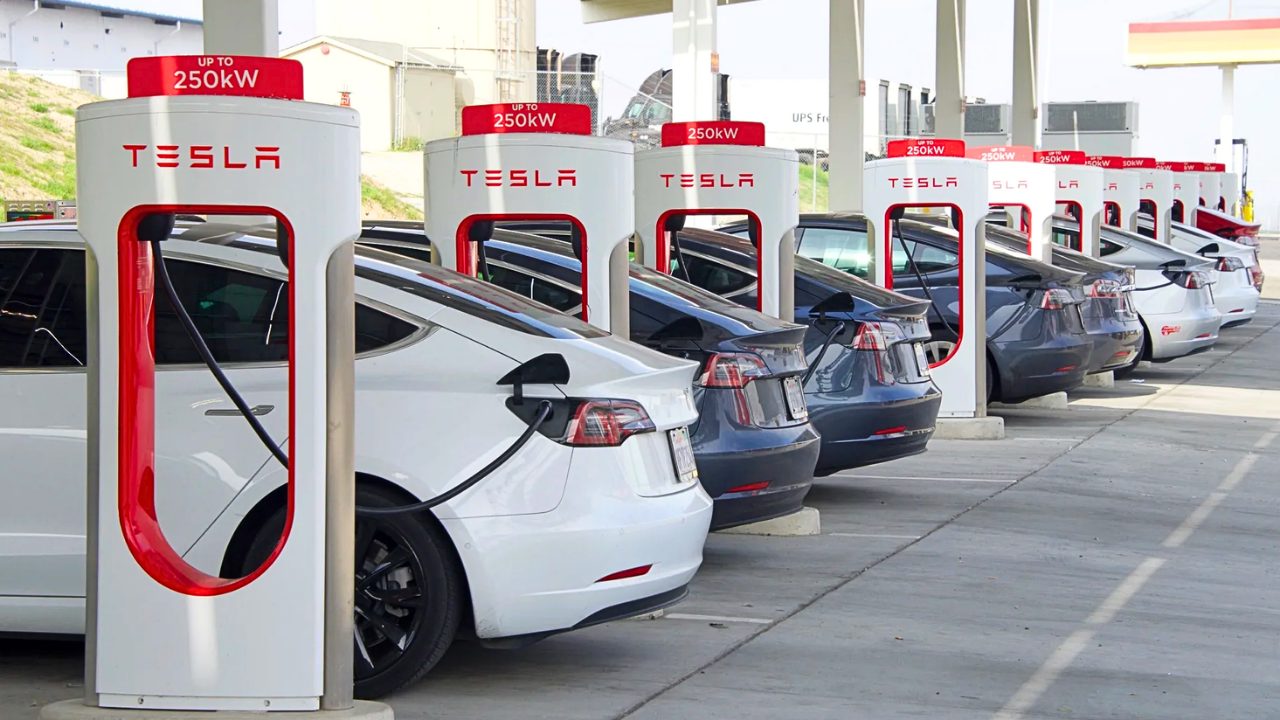
Tesla has submitted plans for a 400-stall Supercharger megasite in Yermo, California, the largest single EV charging installation ever announced anywhere on Earth. Based on Tesla’s confirmed per-stall hardware costs, comparable infrastructure deployed at Lost Hills, and the full six-phase buildout scope, including solar canopies, Megapack battery storage, grid interconnection, land acquisition, and on-site retail construction, total project investment is estimated at approximately $108 million. Nothing remotely close to this scale exists in the global EV charging landscape. Tesla is not catching up to demand; it is building infrastructure the industry has never seen before.
It Just Broke a Record It Set Four Months Ago

The stunning part is not just the size; it is the speed. Tesla’s Lost Hills Supercharger in California, known as Project Oasis, reached full operation in November 2025 with 164 stalls, making it the largest Supercharger station in the world at that time. That record lasted less than four months. The Yermo announcement, confirmed on March 6, 2026, renders Lost Hills obsolete before most drivers even knew it existed. Tesla is now racing against itself and winning by a margin of 2.44 times.
Yermo Is No Accident, It Is Strategic

Yermo sits on Interstate 15 in the Mojave Desert, directly on the most heavily travelled EV corridor in North America, the route connecting Los Angeles to Las Vegas. Charging demand on this stretch is well-documented as one of the highest-pressure bottlenecks in the United States, particularly during peak travel periods. Tesla Supercharger development analyst MarcoRP, who first posted the plans on X, put it plainly: “Tesla is planning an absolutely massive Supercharger expansion in Yermo, California.” This is a calculated intervention at a known chokepoint, not an arbitrary expansion decision.
400 Stalls Is Not a Number, It Is a Statement
To understand what 400 stalls means, consider the scale progression. Standard Supercharger sites typically feature 20 to 40 stalls. Tesla’s Barstow station, which held the size record for years, tops out at 120. Lost Hills pushed that to 164. Yermo more than doubles it. Phase one alone, 72 stalls, represents nearly 43.9 percent of Lost Hills’ entire completed capacity. The Driven, which first reported the story, confirmed the site will be built over the course of 6 phases with each phase adding toward a final count exceeding 400 next-generation V4 chargers.
Next-Gen Hardware Makes This Possible

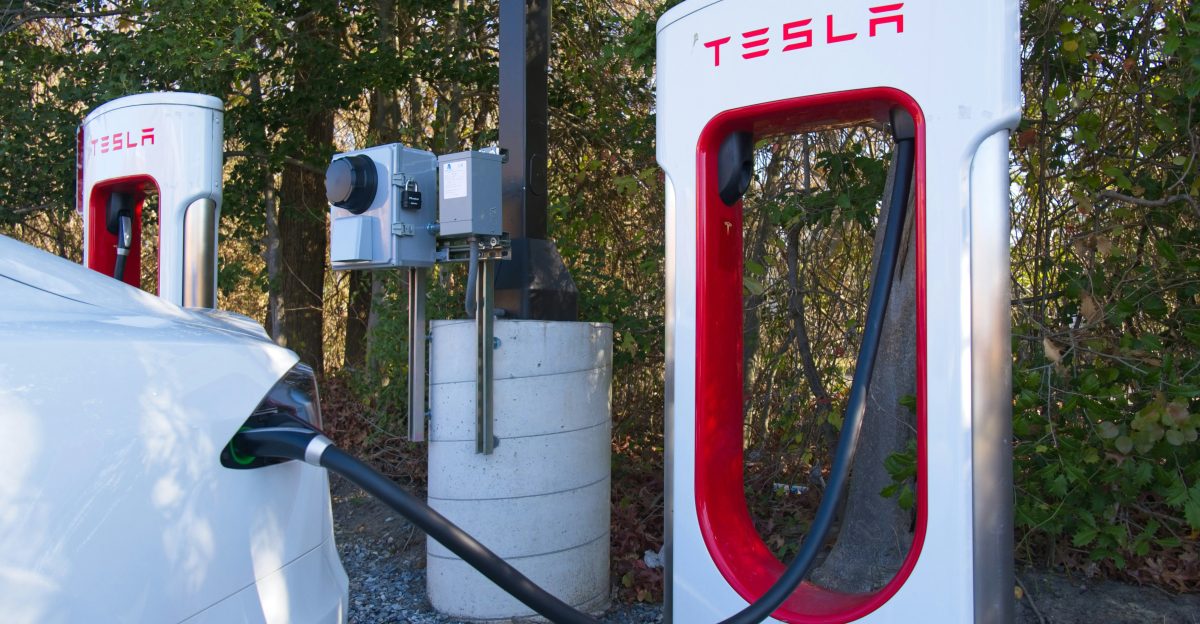
Every stall at Yermo will be equipped with Tesla’s upgraded V4 Supercharging cabinets, first unveiled in November 2024. These units operate between 400 and 1,000 volts, delivering up to 500 kilowatts per stall to compatible vehicles. Critically, each cabinet now supports up to eight stalls, double the capacity of earlier V4 hardware. That engineering advancement is what makes a 400-stall site logistically viable, reducing the physical footprint of back-end electrical infrastructure while dramatically increasing throughput at a single location.
Not Just for Tesla Drivers

The V4 hardware is fully compatible with vehicles from Hyundai, Kia, Porsche, and other manufacturers using the NACS and CCS standards. Since Tesla began opening its Supercharger network to non-Tesla EVs in 2023, flagship sites have increasingly functioned as shared public infrastructure. A 400-stall site on the I-15 corridor is not a private amenity; it is a regional charging hub that will serve the entire EV-owning public regardless of brand, making Yermo one of the most broadly accessible charging destinations on the continent.
Solar Canopies and a Destination Hub Model

Published plans for the Yermo site include multiple solar canopies positioned above the charging bays, consistent with Tesla’s approach at its most advanced stations. The site is located within a commercial development called Eddie World 2, which incorporates a 10,100 square foot Cracker Barrel, a 4,300 square foot McDonald’s, and a 3,800 square foot convenience store. This amenity-integrated model transforms a charging stop into a destination, reducing driver frustration during charge times and mirroring the infrastructure blueprint Tesla proved out at Lost Hills.
The Investment Behind the Numbers

At Tesla’s confirmed per-stall hardware cost of approximately $40,000 to $45,000, as stated by Tesla’s own Director of Charging for North America, 400 stalls represents roughly $16 to $18 million in charging equipment alone. But the full project cost goes well beyond stall hardware. Lost Hills required an 11-megawatt solar array, ten Tesla Megapacks totalling 39 megawatt-hours of storage, 30 acres of land, and full civil construction. Factoring in equivalent or larger energy infrastructure, grid interconnection, land, civil works, and retail construction across a six-phase buildout, total project investment is estimated at approximately $108 million, a figure that may prove conservative given Yermo’s expanded scope.
A Record-Breaking Pace With No Sign of Slowing

The acceleration is what separates this moment from ordinary infrastructure news. Barstow held the Supercharger size record for years at 120 stalls. Lost Hills displaced it and was itself displaced in under four months. The progression, from 120 to 164 to 400 stalls, is not linear growth. It is exponential scaling, and the six-phase structure of Yermo suggests Tesla has already planned beyond it. “With the number of EVs increasing by hundreds of thousands globally, more reliable fast chargers will be needed,” The Driven noted, reflecting the consensus driving Tesla’s accelerating infrastructure investment.
The World’s Charging Networks Just Got a New Benchmark

Globally, no competitor is close. Australia’s largest fast-charging site, located in Goulburn, New South Wales, operates just 20 stalls as of early 2026. The 400-stall Yermo megasite does not merely set a new record; it resets the entire frame of reference for what EV charging infrastructure can and should look like. For every network operator, government body, and automaker watching, Yermo is both a challenge and a warning: the bar has moved dramatically, and it moved in four months.
Sources:
“Tesla to build world’s biggest supercharger site with 400 stalls.” The Driven, March 2026.
“Tesla preps to build its most massive Supercharger yet with 400+ V4 stalls in Yermo, California.” Teslarati, March 2026.
“Tesla plans world’s largest Supercharger with 400 stalls in Yermo, California.” Drive Tesla Canada, March 2026.
“Tesla unveils Oasis, a new Supercharger concept with its own solar farm and Megapacks.” Electrek, October 2024.
“Inside Tesla’s Lost Hills Oasis Supercharger, the world’s largest fast-charging site.” Various EV industry reports, 2025.