$1.66 Trillion In US Auto Debt Hits Great Recession Levels—1.73M Cars Already Seized
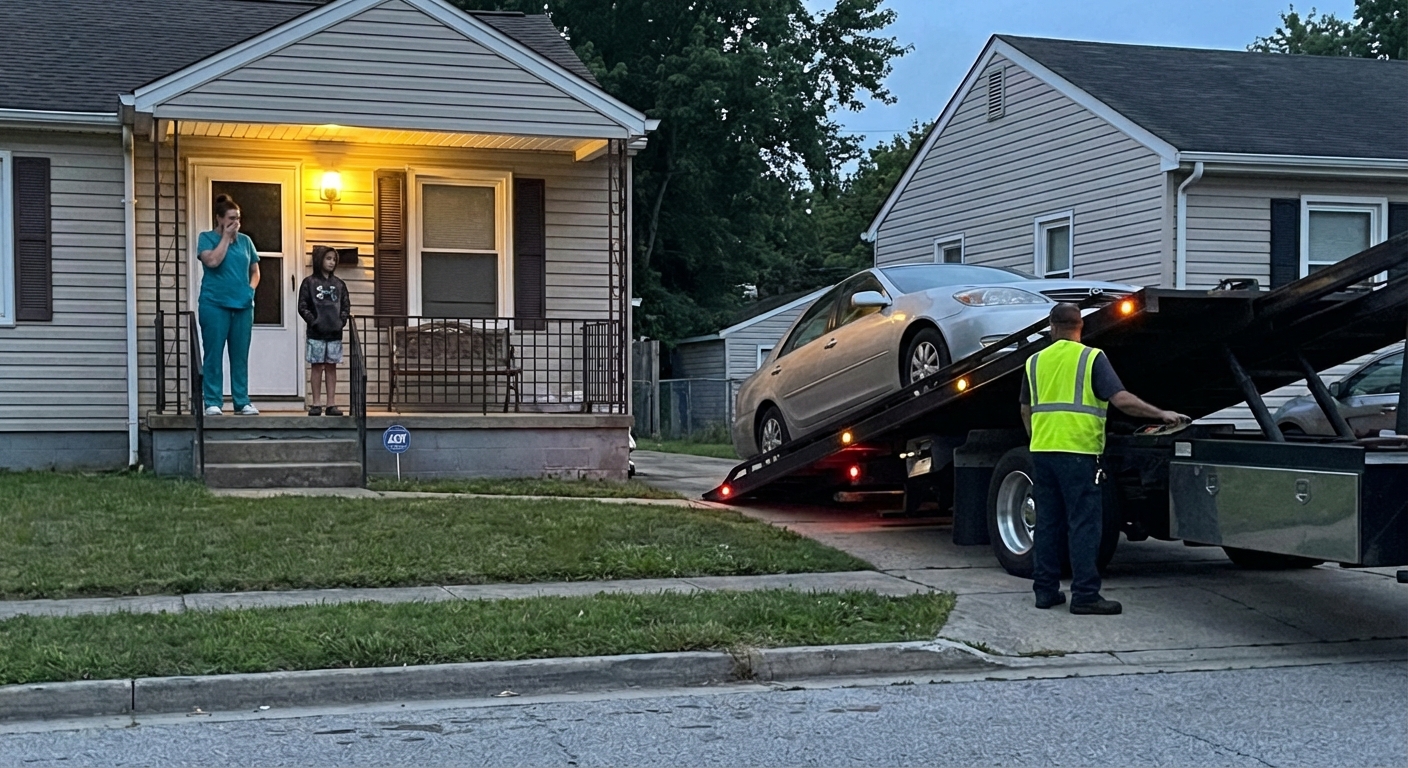
Somewhere tonight, a tow truck is backing into a driveway without warning. No court order. No knock on the door. Just a driver with a GPS pin and a repo hook. In 2024, that scene played out 1.73 million times across America, the highest repossession count since the worst year of the financial crisis.
The borrowers losing those vehicles aren’t all people who made bad choices. Increasingly, they’re people who did everything right. And the number that explains why starts with a T.
The Debt That Dwarfs Everything

Americans now owe $1.66 trillion in auto debt, the second-largest consumer debt category after mortgages. That number grew as average new-car payments reached $767 a month and used-car payments hit $537. Insurance added another gut punch: $2,638 annually in 2025, up 12% in a single year.
Fifty-eight percent of insured drivers now call that premium a financial burden. Thirty percent admit they’ve driven without coverage entirely. The monthly math stopped working for millions of households before a single payment went late.
Good Credit Used to Mean Something

The comfortable assumption has always been simple: keep your credit score up, make payments on time, and you’re safe. That assumption is dead. Borrowers with credit scores in the 620–679 range are now twice as likely to fall behind on auto loans as they were before the pandemic.
Super-prime borrowers, those with scores above 781, saw severe delinquencies surge over 300% year-over-year across credit products. Same people. Same discipline. Completely different math. The system changed the price of everything except wages.
Worse Than 2009, by the Numbers

The 60-plus-day delinquency rate hit 1.38% in Q1 2025. The Great Recession peak was 1.33%. Subprime delinquencies reached 6.6% in January 2025, the highest since tracking began in 1994. Defaults exceeded 2.3 million in 2024, surpassing pre-recession peaks. Repossessions jumped 43% from 2022 to 2024.
Every major metric now matches or exceeds the worst financial crisis in modern memory. Except this time, the regulators who proved they could act chose to walk away instead.
The Machine That Makes Debt Permanent

Here’s how the trap works. In Q4 2025, 29.3% of trade-ins carried negative equity, the highest share since Q1 2021. The average underwater borrower owed $7,214 more than their car was worth, an all-time record. When they traded in, that loss rolled into the new loan.
The new monthly payment for those buyers averaged $916, $144 above the industry norm. And 40.7% of those negative-equity purchases got financed with 84-month terms. One bad loan becomes two. By design, not by accident.
The Hidden Markup on Your “Good” Rate

Nearly 80% of loans for borrowers with prime credit scores carried interest-rate markups added by dealers, according to the Consumer Federation of America. The dealer pockets the spread. The borrower never sees it broken out.
Deep subprime borrowers face APRs of 21.6% on used vehicles, rates that rival credit cards. Meanwhile, nonbank lenders now originate the majority of auto loans, up from 40% in 2009. Less regulation, more aggressive terms, wider reach. The lending market shifted toward extraction while nobody was watching the door.
Who Gets Hit Hardest

Mississippi’s delinquency rate is nearing 10%. Louisiana sits at 8.4%. Georgia at 7.8%. Gen Z borrowers carry the highest delinquency rates of any age group, entering adulthood already underwater. Black and Latino neighborhoods face higher debt per borrower and greater repossession risk. Loan denial rates doubled from 6.7% in June 2024 to 15.2% by October.
As the Consumer Federation of America put it: “When auto loan delinquencies are rising, serious financial problems are brewing in American households.” Losing a car means losing a job means losing everything after it.
The Regulators Who Walked Away

In August 2024, the CFPB proposed reducing its supervision of auto lenders nationwide. Under its current leadership, the FTC has not brought a new enforcement case against a car dealership, even as deceptive pricing ran rampant. By March 2026, the FTC sent warning letters to 97 dealership groups about junk fees and hidden charges. Letters. Not lawsuits.
The CFA’s report called the stress in the auto finance marketplace “a glaring warning sign for policymakers to reexamine this market and root out exploitative conduct.” Policymakers heard the warning and retreated.
The Spiral That Hasn’t Stopped

Early-stage delinquencies (30–59 days past due) hit 1.13% in September 2025, the highest in five years. TransUnion projects the delinquency rate will reach 1.54% by year-end 2026. Repossession stays on a credit report for seven years. Deficiency lawsuits can chase borrowers for a decade.
Borrowers aged 18–29 are transitioning into serious delinquency faster than any other group, locking an entire generation into a debt-entry trap that delays homeownership, family formation, and retirement savings by years.
The Playbook Nobody Stopped

Every seven-year loan, every rolled-forward negative equity balance, every hidden dealer markup converts temporary affordability strain into permanent debt. The system profits twice: once on the inflated sale, again by financing the loss into the next vehicle.
A 10% payment reduction lowers re-default probability by roughly 13%, according to Federal Reserve research. The fix exists. The industry has no incentive to use it. And the agencies built to force their hand sent letters instead of subpoenas.
Sources:
Consumer Federation of America — Driven to Default: The Economy-Wide Risks of Rising Auto Loan Delinquencies — September 10, 2025
Experian — State of the Automotive Finance Market Report: Q4 2025 — March 5, 2026
Edmunds — Q4 2025 Insights Report — January 14, 2026
Cox Automotive (via Bloomberg) — 2024 Year-End Repossession and Default Data — March 2025
Federal Trade Commission — FTC Warns 97 Auto Dealership Groups About Deceptive Pricing — March 11, 2026
Federal Reserve Bank of New York — Quarterly Report on Household Debt and Credit, Q4 2025 — February 10, 2026