Families Close To Tesla Showrooms Ordered To Flee Across 3 Gulf Nations By 8 PM Tomorrow
Funding secured. Elon Musk typed the words into his phone on an August afternoon in 2018 and hit post — and the Saudi deal he’d been dangling in public, the claim that the Kingdom’s sovereign wealth fund was backing a Tesla buyout, collapsed in full view of the world. The SEC came after him. A $20 million personal fine. A combined $40 million split with Tesla. His chairman’s seat, gone. The Public Investment Fund walked and put its billions into Lucid instead. Saudi Arabia didn’t slam a door. It didn’t need to. It just went quiet.
In the Gulf’s exploding EV market, quiet from Riyadh meant BYD moved in, Lucid moved in, everyone moved in, while the world’s most famous electric car company stood on the outside, pressing its face against the glass it couldn’t afford to install. Nearly seven years of that. Nearly seven years of nothing.
He Got the Call and Built Like a Man, Making Up for Lost Time
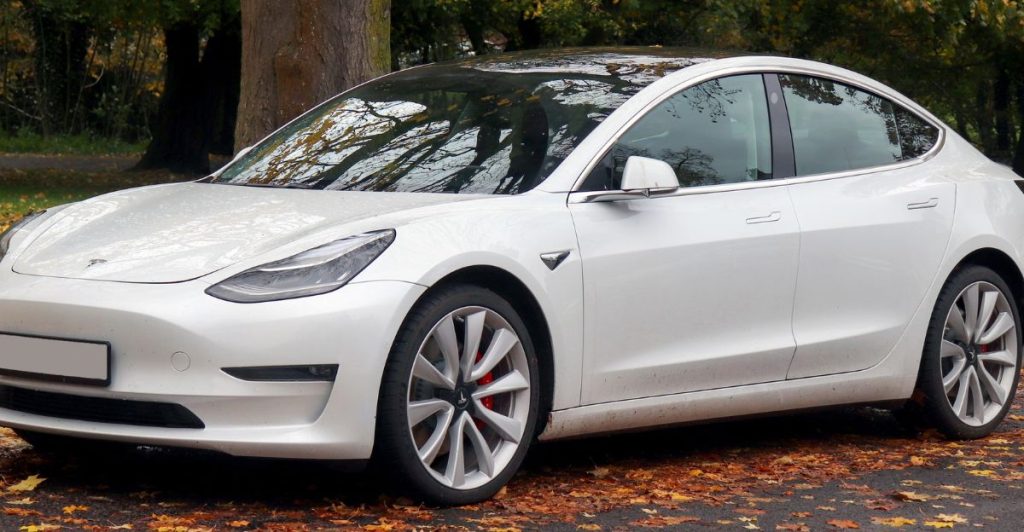
April 10, 2025. Bujairi Terrace, Riyadh. The crowd wasn’t browsing… they’d been waiting. Model 3 from SAR 169,990. Model Y from SAR 199,990. Then Musk landed the Cybertruck announcement like a flare going up: coming to Saudi Arabia by year’s end, first deliveries outside North America. Superchargers went live the same week — Al Nakheel Mall in Riyadh, Mall of Arabia in Jeddah, and Al Nakheel Mall in Dammam, each with 8 stalls, 275 kilometers of range back in your battery in 15 minutes.
By the end of the year: 48 Supercharger stalls across four Saudi cities, showrooms, service centers, Rangers on call. He didn’t ease in. He detonated. Seven years of locked doors, and Musk came through swinging, and for about ten months, it looked like the kind of comeback story that gets written up in business school. Then February happened.
The Night the Middle East Stopped Breathing
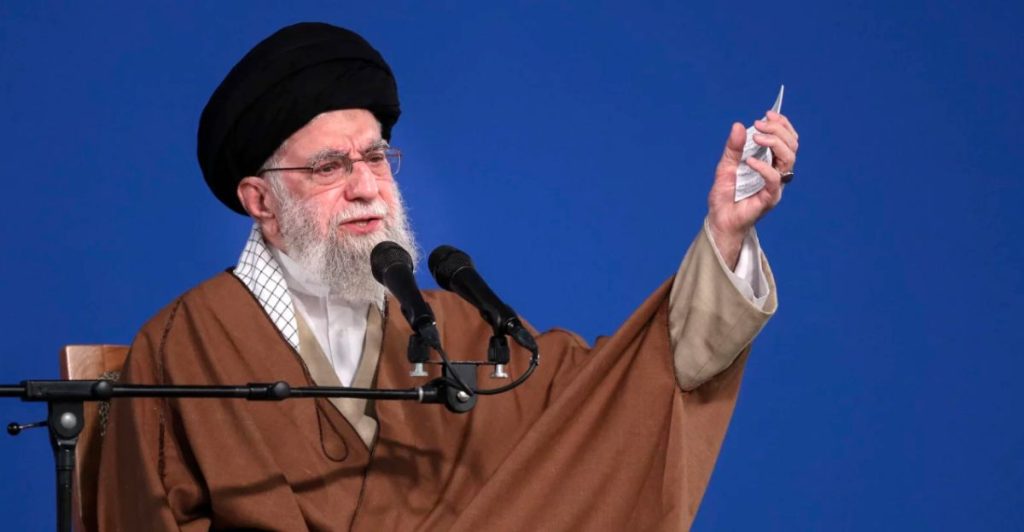
The strike came on February 28, 2026. US and Israeli forces in a joint operation in Tehran. Supreme Leader Ali Khamenei, who has been running Iran for nearly 37 years, the longest-serving Supreme Leader since the Islamic Revolution, was killed. Gone. The Gulf didn’t panic in the streets. It went very, very still. The kind of still that people who’ve lived through regional conflict recognize immediately. Energy markets blew. Families started making lists of their own — passports, cash, what fits in one bag. Into that silence, Musk made a move: free Supercharging at every Tesla station in the UAE, Saudi Arabia, and Qatar, no charge, effective immediately.
A gesture of solidarity. A signal that Tesla was here, staying, standing with the region. What it also did, and nobody could have seen this coming, was to put a lit neon sign above every single one of Tesla’s 30-plus public charging stations in three countries. America’s most visible car company. Right here. Open. Come find us. Someone in Tehran was already taking notes.
The List. Read Every Name.
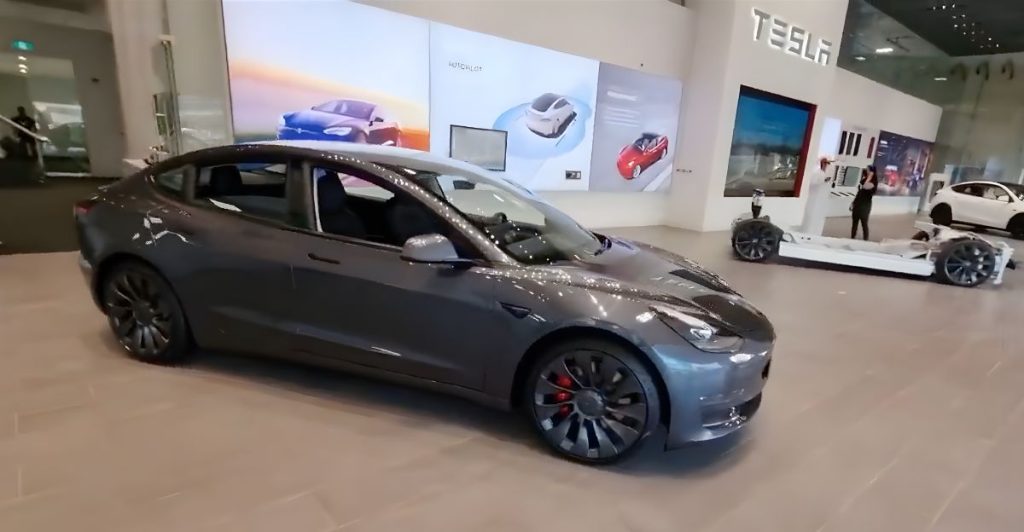
March 31, 2026. Iran’s Islamic Revolutionary Guard Corps published a statement through Sepah News. Eighteen American companies were named formally as legitimate military targets. Their Gulf facilities: designated strike zones. The people working inside them, and every family living within a kilometre: ordered to evacuate by 8:00 PM Tehran time, April 1. Cisco. HP. Intel. Oracle. Microsoft. Apple. Google. Meta. IBM. Dell. Palantir. Nvidia. JPMorgan Chase. GE. Boeing. Spire Solutions. G42. Tesla.
Palantir — the company that built the targeting software the US military runs. Boeing — the company that manufactures the jets dropping the bombs. NVIDIA — whose chips are inside the AI systems calling the strikes in real time. These are the companies on this list. Companies that have spent years embedding themselves into the architecture of American military power. And right there between JPMorgan Chase and General Electric, a car company. A charging network. A showroom with a Model Y in the window and a poster about range anxiety. Same list. Same deadline. Same threat of destruction.
Tesla Has No Army. It Has Something Worse
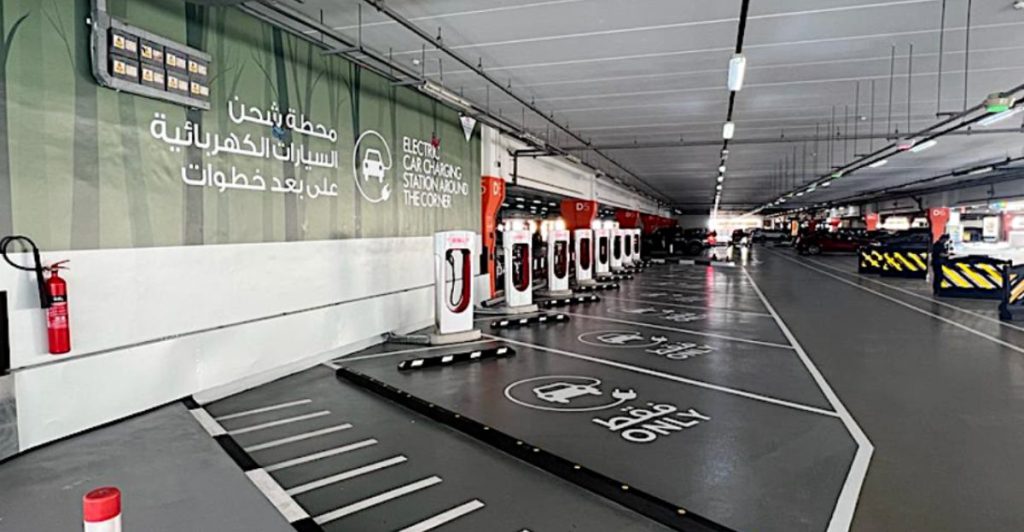
Tesla has zero defense contracts. No weapons programs. No satellite surveillance. No targeting algorithms. Nothing in a Model Y has ever guided a missile or tracked a human being. The IRGC’s own statement declared that “the main element in designing and tracking terror targets are American ICT and AI companies”, published through Sepah News, March 31, 2026. That indictment lands on Palantir like a glove. On Tesla, it lands like a mistake until you pull back and look at the map.
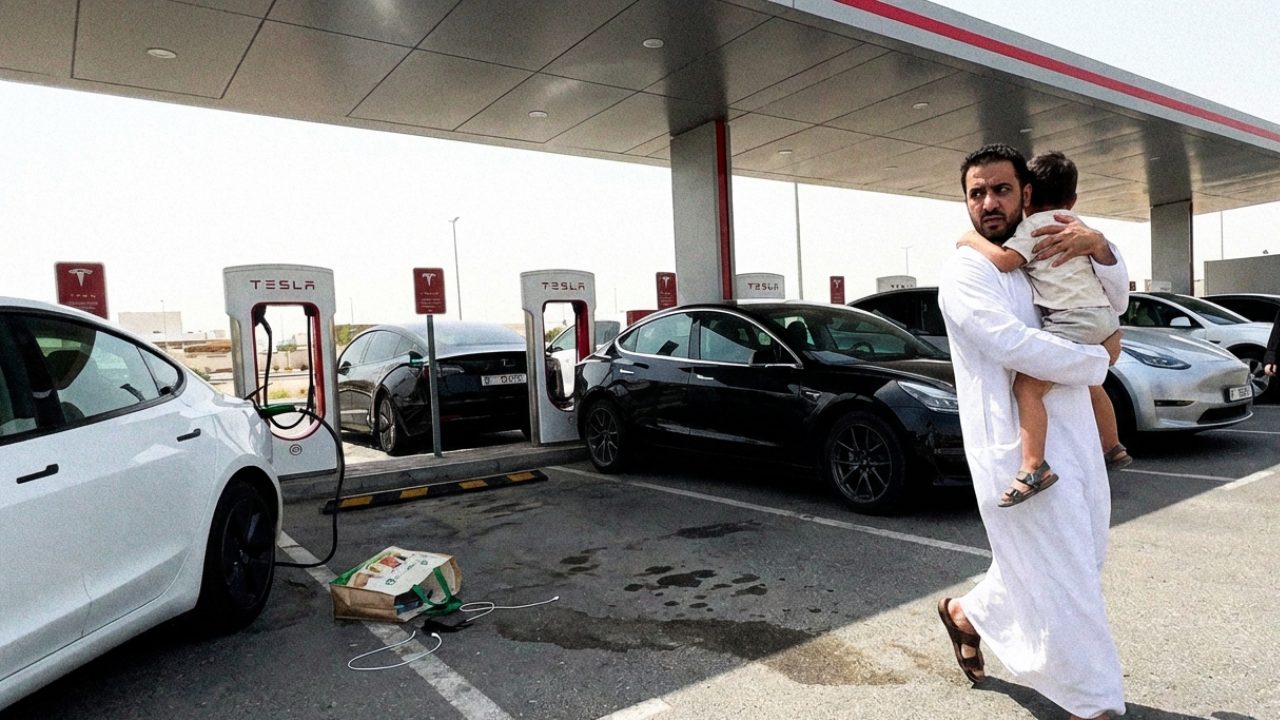
Thirty-plus Supercharger stations across three countries. Every single one of them is in a public mall, on a busy road, open to any driver, any day, any hour. No fence. No security desk. No controlled access of any kind. The IRGC didn’t put Tesla on this list because its cars kill people. They put Tesla on this list because its chargers are everywhere, and in a war where American commercial presence is the target, nowhere is more exposed than a company that deliberately made itself impossible to miss.
Someone in Riyadh Doesn’t Know Yet
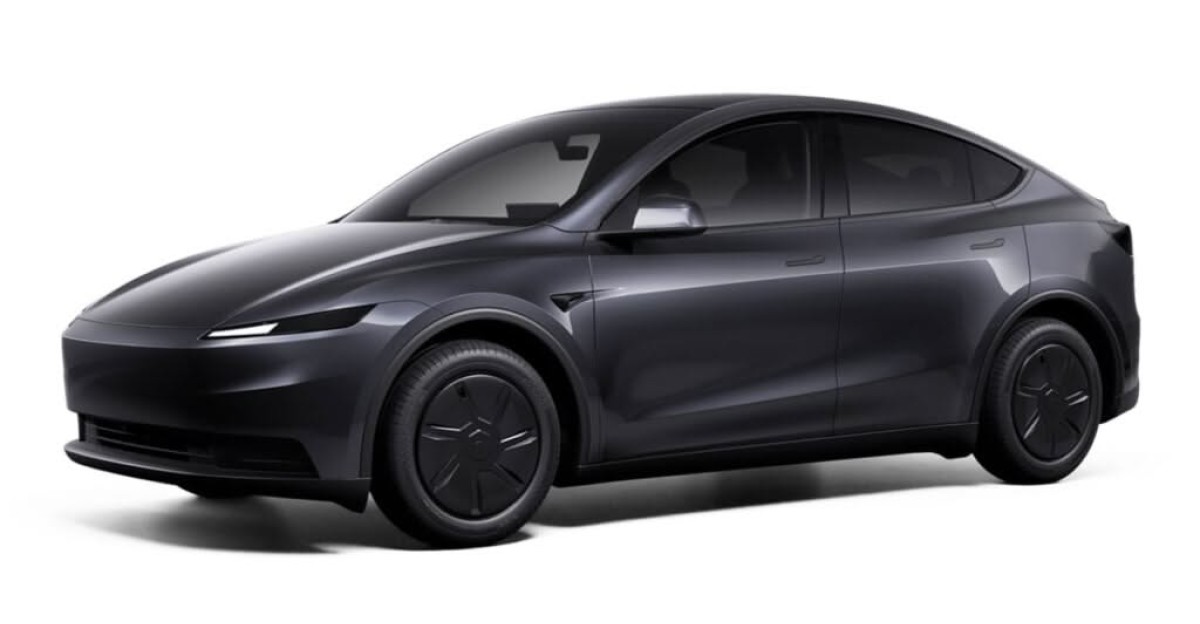
Last month, a Model Y Long Range AWD left the Tesla Center in Riyadh. SAR 229,990. Whoever bought it built the habit fast… they all do. Plug in at night, wake up full, stop thinking about it. The charger at Al Nakheel Mall has 8 stalls, 275 kilometers in 15 minutes, is marked green on the Tesla app, and is reliable as a light switch. Or it was. This morning, that charger sits inside an official evacuation perimeter. The car is fine. The range is fine. But the network that car was sold on, the invisible infrastructure that makes EV ownership actually work in a city without home charging on every block, has an expiry time stamped on it now that wasn’t there when the ink dried on the finance agreement. Maybe the owner knows. Maybe they opened their phone this morning and saw the news, and sat very still for a moment in their driveway. Maybe they haven’t seen it yet. Somewhere in Riyadh tonight, that car is plugged in. And the app still says green.
Every Other Company Built Fortresses. Tesla Built Storefronts
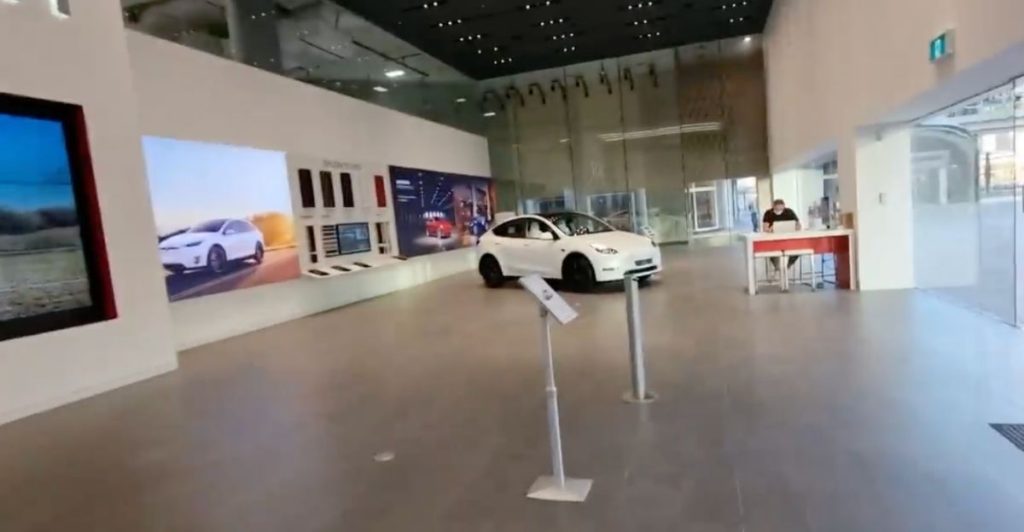
Walk up to a Microsoft Gulf data center. You won’t get past the gate. Cisco’s regional offices are in corporate towers with controlled access and security desks. Boeing’s Gulf presence is essentially invisible — contracted, gated, not something you stumble across on a Saturday afternoon. Now walk into any major shopping mall in Dubai, Riyadh, or Doha. You’ll find a Tesla Supercharger in the parking structure and a showroom with the lights on and a sales rep ready to talk. That’s the strategy.
That’s the whole strategy, be the most visible, most accessible, most unavoidable American brand in the region. It worked brilliantly for selling cars. It worked so well that when the IRGC needed maximum-pressure targets with maximum civilian exposure, the answer was obvious. Same decision that won the market. Different week. Entirely different stakes.
The Company That Refused the Pentagon Isn’t On the List

Anthropic — the AI company with a contract worth up to $200 million with the Pentagon — told the Defense Department that Claude would not be weaponized for mass surveillance of Americans or for fully autonomous weapons. That was the line. Wouldn’t cross it. Defense Secretary Pete Hegseth’s response: Anthropic is a “supply chain risk to national security,” contract terminated. The companies that handed over the keys — Palantir, Nvidia, Oracle, IBM — the ones that said yes, take it, use it however you need — are named on the IRGC target list.
Anthropic, the one that got punished in Washington for saying no, doesn’t appear anywhere on Tehran’s board. The refusal that cost them their Pentagon contract turned out to be what kept them off the kill list. Nobody planned that. Nobody could have. It’s just the absurd, brutal geometry of a war fought with AI as the primary weapon, and the companies that armed it most completely are now the ones being targeted.
Two Thousand Drones. Do The Math
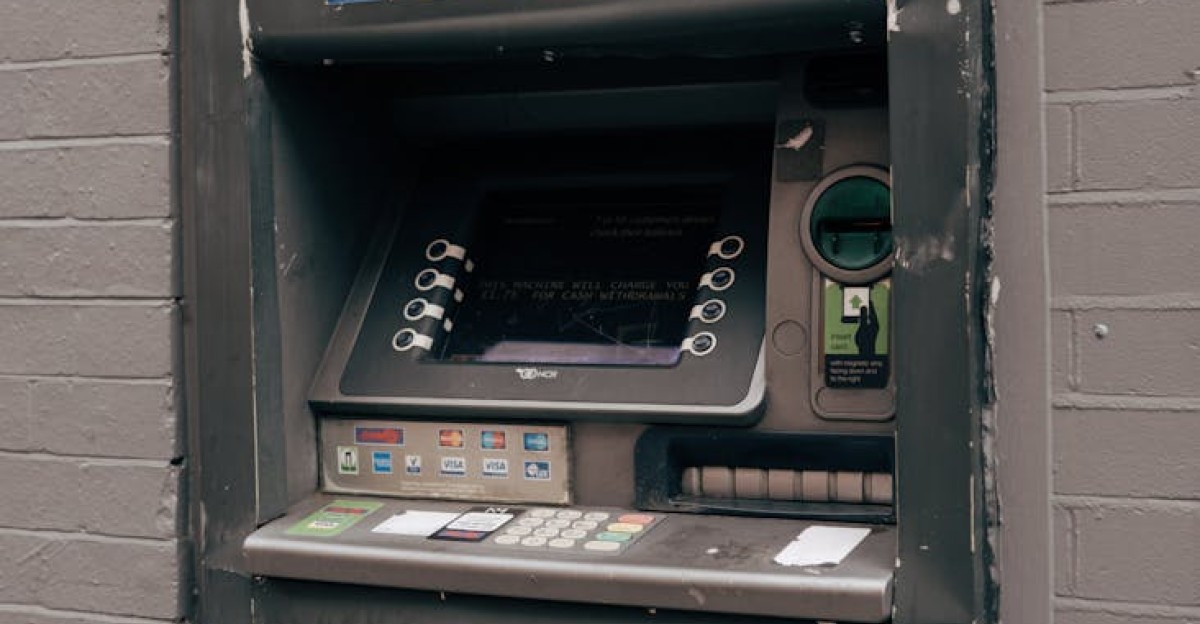
Iranian drones struck Amazon Web Services commercial cloud facilities in the UAE and Bahrain, the first deliberate military strike on American commercial cloud infrastructure in history. Banks went dark. Payments failed. People stood at ATMs staring at frozen screens, no idea why. Since February 28, Iran has fired more than 500 ballistic missiles and nearly 2,000 drones. Two thousand. The US military claims 90 percent interception across categories. The UAE claims 94 percent on drones, 92 percent on ballistic and cruise missiles.
Those are extraordinary numbers, genuinely impressive air defense performance. And across weapon types and engagement rates, something still gets through. Every time. A Supercharger canopy is aluminum and cables above an open parking lot. It is not designed to absorb anything. It is designed to be easy to find and easy to use. Both of those things are still true tonight.
The App Still Says Green
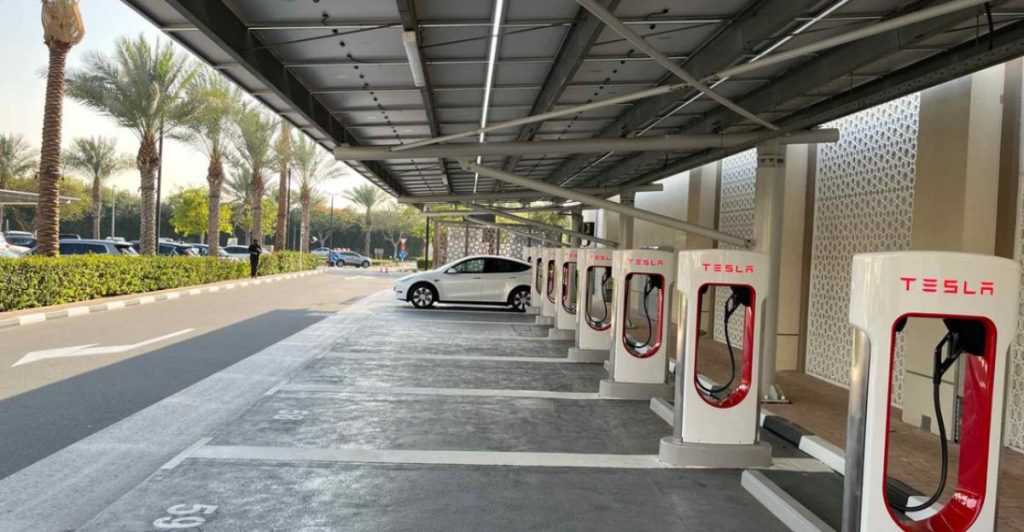
The State Department told Americans in Saudi Arabia to shelter in place. The IRGC told everyone within a kilometer of these facilities to leave. Tesla issued no statement, and Musk posted nothing. The Model 3 is still on the website. The Supercharger map, every station in Riyadh, Jeddah, Dammam, Dubai, Doha still glows green. Available. Open. Ready. Somewhere in a mall parking lot right now, under the lights, a Model Y is plugged in, charging. The owner is inside doing what people do. They’re not thinking about intercept rates. They came to get dinner, or pick up something for the house, or let the kids ride the escalator one more time.
The deadline is tonight. The market Musk spent nearly seven years bleeding to get into, the one he cracked open at Bujairi Terrace on April 10, 2025, with a Cybertruck and a crowd and the desperate energy of a man who had something to prove, is sitting out there right now in three countries. Lit up. Doors open. Waiting to find out what 8 PM looks like when it finally arrives.
Sources:
“Tesla Launches in Saudi Arabia” — AP News
“IRGC Threatens Strikes on US Tech Giants Across the Middle East” — i24 News
“Iran Threatens to Start Attacking Major US Tech Firms on April 1” — Wired
“Iranian State Media Confirms Supreme Leader Khamenei is Dead” — Axios
“Pentagon Designates Anthropic Supply Chain Risk Over AI Military Use” — The Hacker News
“Elon Musk Settles SEC Fraud Charges” — SEC Official Press Release