$225M Valeo Plant Brings 2,000 Jobs to One of Texas’ Poorest Regions
Last week, Valeo committed $225 million to build a major automotive technology plant in McAllen, Texas, bringing 500 jobs to one of the poorest regions in the United States. The French company, which reported about $22.7 billion in 2025 revenue, will produce advanced computing systems for General Motors’ next generation vehicles at a new 337,000 square foot facility. Local leaders see it as the largest industrial investment in Hidalgo County in over 30 years. For a region where about 25% of residents live in poverty, the impact could be immediate, and the forces behind it reveal a deeper shift.
The Largest Bet In Decades
Local officials confirmed on March 25 2026 that this project represents the biggest industrial investment in Hidalgo County in over 30 years. The 337,000 square foot facility will rise inside CiL Capital’s McAllen Nearshoring Industrial Park, a site equipped with heavy power infrastructure, high speed connectivity, and clean manufacturing capabilities. Valeo’s March 24 2026 announcement described the contract as one of the largest orders in its history. Leaders are not framing this as routine development. They see something much bigger forming beneath the surface as timelines accelerate.
Jobs That Could Change Families
Valeo and local leaders estimate about 500 jobs will come from the McAllen plant, spanning engineering, logistics, finance, human resources, and skilled manufacturing roles. Hidalgo County officials estimate the plant could support approximately 2,000 total jobs across the region when accounting for indirect and induced employment from supply chain activity and local spending. These jobs arrive in a region where about 24% of Hidalgo County residents live below the federal poverty line, and roughly 50% fall under 200% of that level. Median household income sits near $50,000 compared with more than $75,000 statewide. Each position carries unusual weight here. But the origin of this opportunity tells a deeper story about why McAllen was chosen now.
Competing On More Than Wages
For years, the Rio Grande Valley was seen as a low wage extension of Mexican manufacturing zones. That perception has begun to shift. Ralph Garcia, chief operating officer of the McAllen Economic Development Corporation, said on March 24 2026, “This wasn’t a Mexico expansion, this was a United States project, and we were competing.” Proximity to Mexican suppliers, USMCA rules, and 25% tariffs on many Chinese auto parts reshaped the equation. Geography that once limited growth became a strategic advantage. That shift explains why attention turned here.
A Border Network Powers Growth
The McAllen facility connects directly into a binational manufacturing network spanning South Texas and northern Mexico. Components produced in nearby Mexican cities move across the border before reaching US assembly plants. Valeo already operates in Rio Bravo, producing smaller computing boxes, while McAllen will focus on central computing units for GM. Industry outlooks project a growing share of vehicles sold in the US will be built domestically as reshoring accelerates. This broader trend explains the timing. Yet the technology itself signals an even bigger transformation ahead.
The Brain Behind Future Vehicles
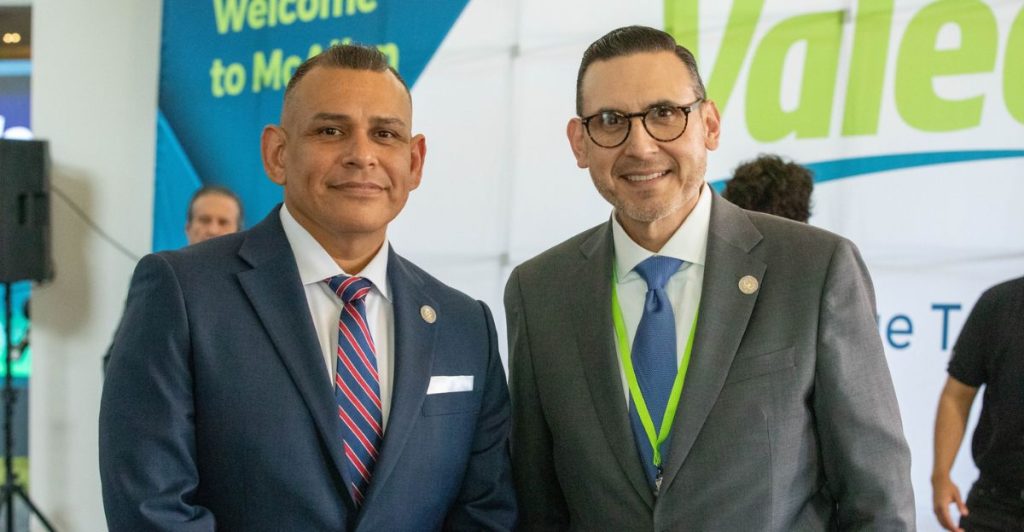
General Motors introduced its latest centralized computing platform in late 2025, aiming to replace dozens of separate modules with a single integrated system. Valeo confirmed on March 24 2026 that McAllen will manufacture this liquid cooled central compute unit. Jeffrey Shay, Valeo’s North America president, described it as “one large brain.” The design promises improved reliability and faster software updates. Fewer components also mean simpler assembly. However, that same efficiency raises a critical issue about suppliers whose parts are no longer needed across the industry.
Hidden Costs Behind New Jobs
The creation of 500 jobs in McAllen comes with a broader industry ripple. Consolidating vehicle electronics into a single system reduces demand for multiple smaller components. Industry observers warn that suppliers across North America could lose contracts as production shifts toward integrated systems like Valeo’s. General Motors emphasized efficiency in its late 2025 briefings, not employment impact. The result could balance gains in South Texas with losses elsewhere. The Valley gains opportunity, but the wider supply chain absorbs disruption. Could total employment remain unchanged despite local optimism?
Policy Changes That Moved The Map
The Valley spent decades pursuing projects like this without success. Global supply chains favored lower cost production in China for years. That changed in 2025 as the United States imposed higher tariffs on Chinese auto parts and reinforced North American sourcing rules under USMCA. Suddenly, companies reevaluated location decisions. McAllen did not move geographically, yet its value changed almost overnight. The plant reflects shifting policy more than long term transformation. That distinction shapes how durable this opportunity may prove as conditions evolve further.
Economic Gains With Limits

If Valeo creates 500 jobs with wages between $30,000 and $50,000, annual payroll could reach roughly $15 million to $25 million. Economic multipliers suggest that may generate about $45 million to $75 million in regional activity each year through local spending. Restaurants, clinics, and small businesses could benefit. County leaders project the facility’s broader economic footprint could sustain roughly 2,000 positions region-wide, though only 500 are direct Valeo hires. The company has indicated it invested in artificial intelligence to improve efficiency and aims to take on more business without proportionally increasing staffing. Efficiency may limit job growth over time. That tension leaves residents weighing promise against long term stability.
A Future Built On Uncertain Ground

Production is expected to begin in late 2027, with hopes that other major suppliers will follow Valeo into South Texas. Some regional leaders say they hope 10 to 15 similar plants could eventually form a manufacturing cluster. That could reshape the Valley’s economic trajectory. Another scenario remains possible. If tariff policies ease after 2028 or global supply chains shift again, the advantage that brought Valeo could disappear. A region that finally attracts major investment may still depend on forces beyond its control, leaving its future delicately balanced.
Sources:
McAllen announces 500 high-paying car manufacturing jobs. The Texas Tribune, March 25 2026
Valeo Breaks Ground on $225 Million High-Tech Plant in McAllen, Texas, for Software-Defined Vehicle Technology. Valeo (PR Newswire), March 24 2026
Valeo is building an advanced manufacturing plant in McAllen with operations planned for 2027. Texas Border Business, March 24 2026
French tech giant breaks ground on massive new plant in South Texas. Houston Chronicle, March 25 2026
Valeo Invests $225M in McAllen. Rio South Texas Region, March 23 2026
Behind the deal: How McAllen landed Valeo’s $225M plant. Rio Grande Guardian, March 24 2026
Automotive Industry Outlook 2026. PwC, 2026