
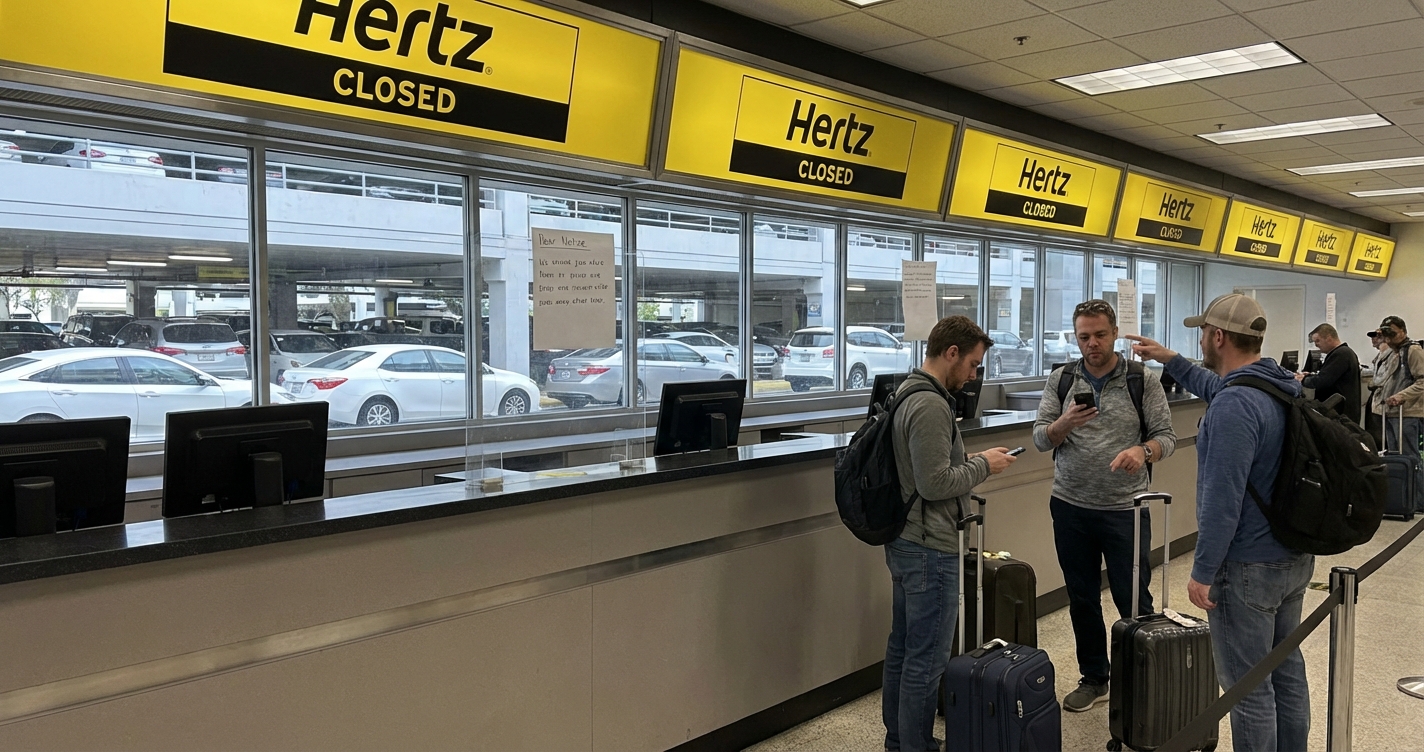
Hertz Faces Renewed Bankruptcy Risk This Year—After Its 2020 Chapter 11
Hertz, the company behind rental counters in airports across the United States, faces renewed bankruptcy risk five years after its 2020 Chapter 11 filing. The 2020 restructuring restored operations but did not remove the vulnerabilities tied to passenger volume and access to affordable debt. Analysts now flag weak credit metrics and cautious outlooks, highlighting that the company’s balance sheet remains sensitive to travel demand shifts. As travelers walk past the familiar logo, the financial machinery behind the counters is quietly under scrutiny, with potential consequences that could ripple through the airport rental sector.
Chapter 11 Came First

Hertz filed for Chapter 11 bankruptcy protection in the United States in 2020, as air travel dropped sharply and airport rental demand disappeared almost overnight. The company restructured and emerged from court supervision in 2021, reopening counters nationwide. Travelers returned, and the brand appeared revived. The restructuring addressed operations and capital at that moment but did not remove the factors that made the company vulnerable. Passenger volume and access to affordable debt remain critical inputs. Five years later, those inputs face renewed scrutiny from credit analysts and market observers. Historical patterns provide context for current risk.
Stability Is Visible

Airport travelers assume prime counter placement equals financial solidity. Visibility creates confidence. Credit agencies track different signals: leverage ratios, liquidity reserves, and refinancing capacity. These metrics identify potential vulnerabilities before they appear at the counter. Hertz carries a cautious or negative outlook from analysts, indicating stress points remain. Those stress points are closer to the surface than most travelers realize. The appearance of a fully staffed counter does not guarantee financial stability. Analyst reports and SEC filings illustrate that even after a 2020 restructuring, the company’s balance sheet and financing remain sensitive to external shocks.
Capital Drives Operations

Hertz sells continuous access to capital, not just cars. Its fleet is financed, and operations rely on rolling debt through refinancing windows at manageable rates. When refinancing costs rise or travel demand dips, the balance sheet becomes a countdown. The 2020 Chapter 11 filing demonstrated what occurs when that countdown reaches zero. SEC filings and credit reports now show the company remains exposed to the same mechanism. Renewed bankruptcy risk emerges if demand or credit conditions shift. Analysts monitor this exposure carefully. The visible rental product hides the financial structure that dictates how long counters remain open.
Passenger Flow Matters

Airport passenger throughput drives Hertz revenue. National data from the Bureau of Transportation Statistics track these flows. When passenger numbers rise, revenue flows, debt gets serviced, and counters remain open. When throughput falls, financial strain increases rapidly. SEC disclosures name macroeconomic conditions and travel volatility as threats. These factors directly influence refinancing risk. The company’s vulnerability to changing travel patterns remains explicit in filings. The model’s reliance on predictable passenger flow shows why analysts remain alert. Current numbers may seem normal, but fluctuations could create conditions that resemble 2020. Financial stability requires constant alignment of demand and financing.
Metrics Predict Risk

Hertz is a publicly traded company with SEC-auditable disclosures. Rating agencies track three bankruptcy indicators: leverage ratios, liquidity reserves, and refinancing schedules. Rising refinancing costs create a “liquidity cliff” for companies with heavy debt. Revenue may fluctuate, but debt obligations do not shrink. That cliff contributed to the 2020 Chapter 11 filing. Recent reports identify weak credit metrics and negative outlooks, which analysts interpret as elevated risk. The structure that failed before remains in place. Each filing and rating update adds context for the present. Observers track these metrics to assess whether conditions could again push the company toward court-supervised restructuring.
Effects Reach Beyond

A major airport rental provider under financial stress affects the broader system. Competitors may adjust pricing or limit fleet availability. Airport services, concessions, and ground transport face immediate demand shocks. Travelers encounter higher costs and fewer options. Employees face uncertainty regarding schedules and job security. A refinancing problem in one company can ripple across the national airport network. The impact spreads quickly. Analysts monitor potential knock-on effects from restructuring scenarios. One firm’s balance sheet can influence pricing, availability, and operational stability across multiple airports. These secondary effects illustrate the scale of systemic exposure.
Patterns Repeat

The 2020 Chapter 11 filing demonstrates how travel-demand shocks can drive court-supervised restructuring in airport rental models. Government agencies document vulnerabilities affecting all passenger-dependent providers. Capital access remains the critical product. Every airport counter functions as a financial node. The pattern is observable and repeatable. When travel declines align with tightening credit, the company faces the same pressures seen five years ago. Analysts interpret these dynamics cautiously. Monitoring historical precedent shows which mechanisms could trigger stress again. Observers track passenger numbers, refinancing conditions, and liquidity levels to gauge whether the company could follow the same path.
Escalation Steps
Financial stress follows a defined sequence: declining travel demand meets refinancing constraints, triggering liquidity pressure, which can lead to restructuring discussions and potential court filings. Hertz experienced this sequence in 2020. Five years later, the sequence remains possible. The company can manage stress through asset sales, covenant relief, or additional financing, but these measures are conditional and not guaranteed. Analysts describe elevated bankruptcy risk rather than certainty. The path to court-supervised restructuring is documented and understood. Tracking the interaction of passenger volume and debt obligations illustrates why the risk persists despite operational appearances.
Restarted Structure

Most travelers will pass Hertz counters without concern. Cars are visible. The business operates on continuous capital access, reliant on steady travel demand and open refinancing. Both factors can change within a single quarter. Asset sales, cost controls, and financing measures attempt to maintain operations. The 2020 structure restarted rather than replaced the previous system. Analysts note that whether the company stalls again depends on market forces outside contracts or counters. Five years after Chapter 11, bankruptcy risk remains attached to the familiar logo. The corporate framework remains conditional on both demand and credit markets.
Sources:
Hertz says coronavirus drove it to bankruptcy. Los Angeles Times, May 24 2020
Car Rental Company Hertz Files For Bankruptcy. Forbes, May 21 2020
Hertz’s Plan Of Reorganization Confirmed By Bankruptcy Court. Hertz Newsroom, June 9 2021
Hertz Exits Chapter 11 As A Much Stronger Company. PR Newswire, June 29 2021
Hertz Global Holdings Inc. Outlook Revised To Negative On Weak Credit Metrics; ‘B’ Rating Affirmed. S&P Global Ratings, November 19 2024
Fitch Affirms Hertz at ‘B-‘; Outlook Negative. Fitch Ratings, August 7 2025