$10B in EV Battery Bets Jeopardized by Design Flaw Toyota’s New Patent Aims to Fix
Every electric vehicle on the road today carries its most expensive component bolted into a rigid steel frame, locked tight against the undercarriage. The engineering logic sounds bulletproof: stronger mounting means safer battery. For fifteen years, nobody questioned it. Then, Toyota’s engineers ran side-impact simulations and watched what rigid mounting actually does to lithium-ion cells during a collision. It transmits collision force directly into the most fragile, most expensive part of the car. The fix they filed changes everything about how batteries survive crashes.
Hidden Tax
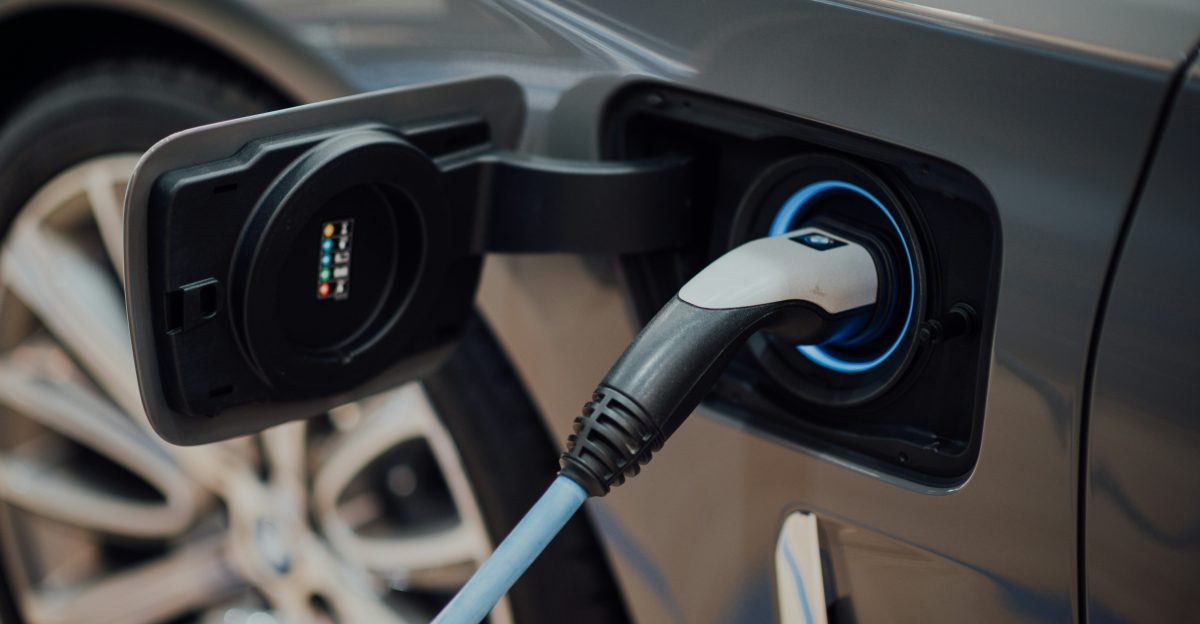
That rigid mounting choice created a financial disaster most EV buyers never saw coming. Electric vehicles cost 49% more to insure than gas-powered cars: $4,058 annually versus $2,732. In Arkansas and Idaho, the premium gap approaches 100%. Julia Taliesin, Insurify report author, put it plainly: “The cost of what’s making up the car, and the cost of the labor to make those repairs, all go into why EVs are more expensive to insure.” Battery packs account for up to 40% of an EV’s total value, and minor fender damage routinely triggers total-loss declarations.
Wrong Diagnosis
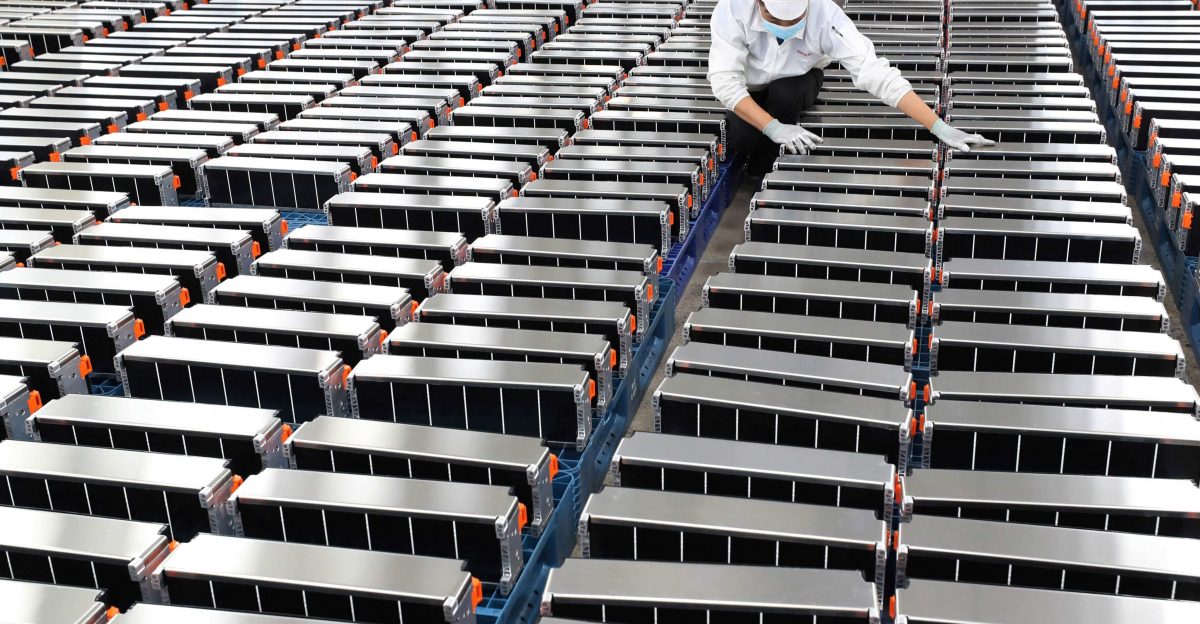
The industry spent billions chasing better battery chemistry, with longer range, faster charging and cheaper cells. Goldman Sachs projects battery costs will reach $80 per kilowatt-hour by 2026. None of that matters when a parking-lot collision destroys a $15,000 battery because the mounting system channeled every joule of impact energy directly into the cells. Thatcham Research surveyed the industry and found 44.6% of insurers and 41.7% of repair professionals named battery damage as their single biggest concern. The problem was never the battery. The problem was the box around it.
Millimeters
Toyota’s patent #20260054558, filed August 2025, moves away from rigid mounting. The battery sits inside a deformable sub-frame that allows controlled, millimeter-level movement during side impacts. Instead of resisting force, the system manages it. Crumple zones have protected passengers for half a century. Toyota applied the same principle to the one component nobody thought to protect. A 50-year-old concept, repurposed for a 15-year-old blind spot.
Force Management
In structural battery designs, cells bear a disproportionate share of collision energy compared to traditional pack layouts, meaning the battery isn’t just storing power; it’s functioning as a structural crash member. Bolting it rigid turns every side impact into a direct assault on cells that rupture under pressure. Toyota’s deformation zone redirects that energy around the pack. Insurers are effectively writing off $10,000+ vehicles for $2,000 repairs because they lack diagnostic tools to assess battery damage. One engineering change could collapse that equation overnight.
Damage Report
The numbers confirm the wreckage. Average collision claim severity for battery EVs hit $5,903 in the U.S. and $6,633 CAD in Canada during Q2 2025. Tesla’s Model 3 accounted for 26.95% of all repairable BEV collision claims, even as the overall battery EV segment claims frequency fell to 2.92%. Canadian BEV claims frequency climbed 8% in a single quarter to 4.83%. Meanwhile, repair cost growth has moderated as technician experience has grown. The cars are getting cheaper to fix. The batteries are still getting totaled.
Chain Reaction
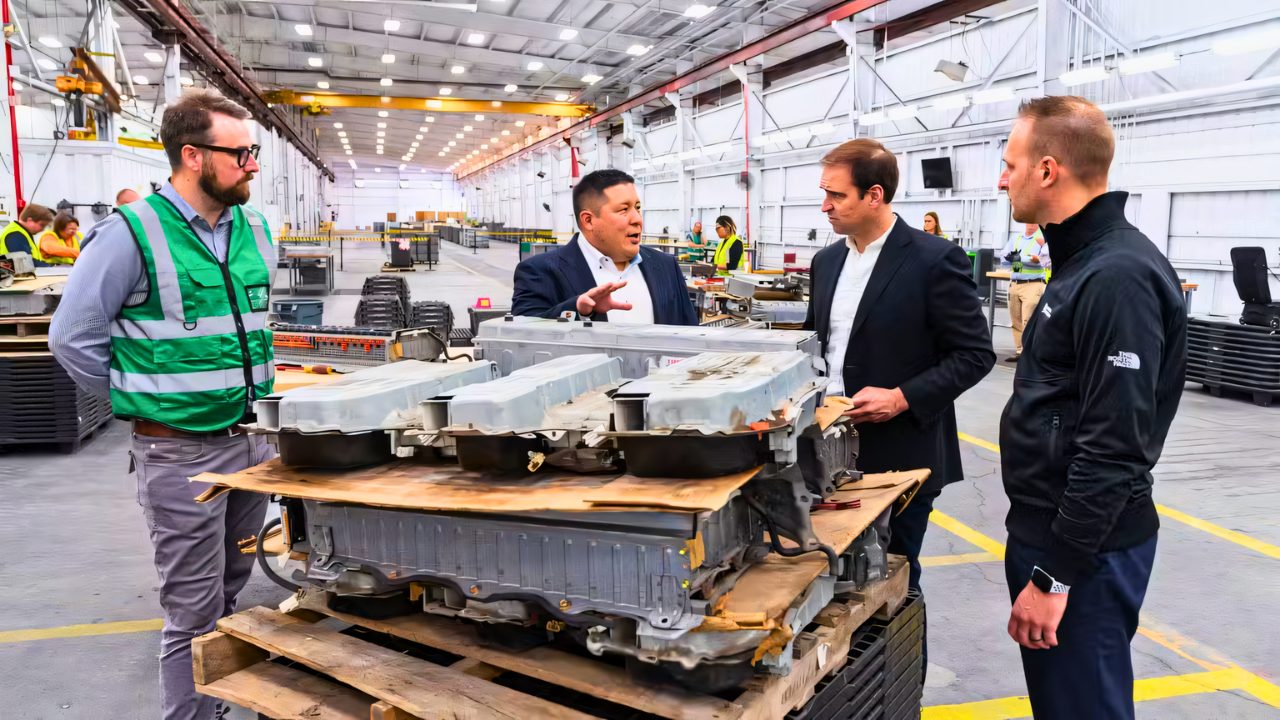
That insurance crisis didn’t stay in body shops. The Federal Reserve Bank of Dallas documented more than ten U.S. gigafactory projects canceled or stalled, representing over $10 billion in abandoned investment. The federal EV tax credit expired September 30, 2025, and 42% of potential buyers reported being less likely to purchase without government incentives. Panasonic’s $4 billion Kansas plant began mass production in July 2025, with 4,000 jobs targeted by the end of 2026, but it now operates in a market where insurance premiums alone erase the ownership savings EVs are supposed to deliver.
New Rule
This patent doesn’t just protect one battery. It establishes a precedent that rigid mounting was always the wrong answer for lithium-ion cells. Thatcham Research’s eight-point blueprint already recommends replaceable protective components at a reasonable cost. The World Economic Forum named structural battery composites a top-ten emerging technology of 2025. Toyota’s 2026 bZ lineup, the 2027 Highlander EV assembled in the U.S., and a solid-state roadmap promising 10,000 charge cycles all feed the same strategy. The doctrine that rigid equals safe just lost its last defender.
Ticking Clock
Toyota’s crumple-zone design targets a market running out of time. New EV transaction prices averaged $55,689 in July 2025, even as incentive discounts hit an all-time high of $9,768 per vehicle. Used EVs listed at $35,263. Only 2.5% of EVs ever need battery replacement, and most fall under warranty. The problem was never durability over the years. The problem was survivability in seconds. If competing manufacturers don’t adopt flexible mounting, their insurance economics stay broken while Toyota’s potentially drops by thousands per vehicle annually.
Open Question
The EV insurance crisis was never a technology problem. It was an architecture problem hiding behind fifteen years of unquestioned engineering consensus. Toyota filed the solution in August 2025. Whether insurers adjust premiums, whether competitors license or replicate the approach, whether the $10 billion in stalled factory investment restarts: none of that is guaranteed. What’s guaranteed is that every future side-impact total-loss claim on a rigidly mounted battery now carries an asterisk. Someone patented the fix. The industry has to decide if it cares.
Sources:
Plante, Michael, et al. “U.S. Battery Industry Cuts Losses, Shifts to New Ventures Amid EV Bust.” Federal Reserve Bank of Dallas, 3 Mar. 2026.
Mandell, Ryan. “Plugged-In: EV Collision Insights Q2 2025.” Mitchell International, 21 Aug. 2025.
“Toyota Finds a Safer Way to Mount EV Batteries.” Autoblog, 28 Feb. 2026.